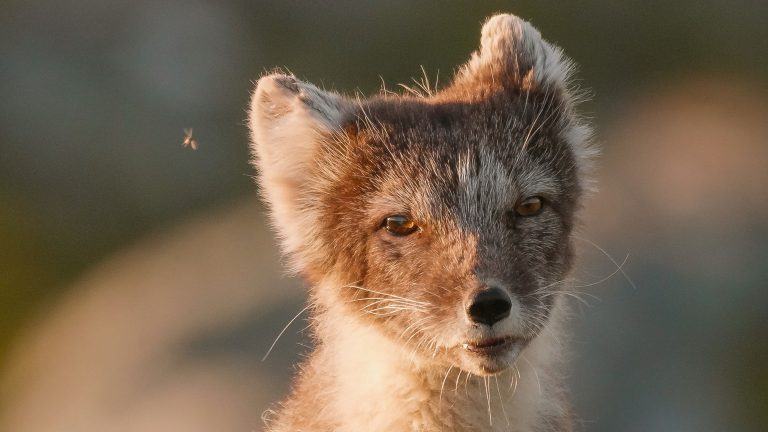
Arctic fox

The group coordinates research and conservation through an international network of Arctic fox specialists. It addresses regional threats linked to climate change, prey dynamics, competition, disease, habitat fragmentation and genetic isolation, while supporting transnational management and regular population assessment.
Coordinator Karin Norén
Assess how climate change, prey dynamics and boreal expansion affect Arctic fox populations.
Improve understanding of diseases and parasites and their demographic effects.
Maintain genetic and demographic connectivity between sub-populations.
Mitigate threats in locally endangered populations through adaptive conservation actions.
Improve early detection of population change through regular status assessments.
On a global scale, the arctic fox is classified as Least Concern. It was however classified as a climate change flagship species by the IUCN in 2009, highlighting habitat loss, disruption of prey cycles and impact of boreal expansion as important threats. Another potential threat is outbreaks of diseases and parasites. Even though there is a knowledge gap regarding the impact of pathogens on a global scale, demographic consequences following outbreaks have been recorded in local populations.
Europe - The arctic fox is legally protected in Sweden (EN), Norway (EN) and Finland (CR). Fur harvesting caused a drastic population decline in the early 1900s. Despite legal protection, the population failed to recover due to interference competition with expanding red fox populations and irregular prey cycles and was on the verge of extinction in the late 1990s. Further, inbreeding depression, sarcoptic mange outbreaks and habitat fragmentation pose further threats.
North America - The arctic fox population on Pribilof island, Alaska is recognised as a distinct subspecies. Since the 1990s, the population is declining with human persecution, reduced prey availability and environmental pollutants identified as contributing factors. At present, there is no legal protection of the Pribilof island population.
Russia - The arctic fox population on Mednyi Island is listed in the state record for rare and endangered species following an outbreak of mange (Red Book of the Russian SFSR, 1983; Red Book of Russia, 1997; Red Book of Kamchatka, 2006).
On a global scale, the imminent threat of climate change is expected to influence arctic fox populations across the distribution range – ranging from melting sea ice in the high Arctic to increasing boreal influence and irregular prey availability in the low Arctic. Accelerated habitat loss and fragmentation are anticipated across the distribution. On a local scale, specific threats should be mitigated through scientifically informed and adaptive conservation actions. In this context, knowledge regarding community-level consequences of climate change, the role of diseases and parasites, connectivity between sub-populations and maintenance of genetically healthy populations are key priorities. Given the expected impact of climate change, the ability to detect population changes at an early stage through regular assessments of population status across the distribution is also essential.